


ASME A17.1 Elevator Video Monitoring Costs
By: Derek Harris | Dialvice CEO | 30+ years’ experience
👉 5 mins saves you 15+ hours!
Updated October 1, 2026
Cutting the cost of elevator video retrofits
Property owners, facility managers, and elevator contractors face strict code enforcement under updated ASME A17.1 / CSA B44 standards.
Section 2.27.1.1.8 mandates two-way text messaging and video display systems for trapped passengers who are hearing- or speech-impaired.
Upgrading from legacy voice phones to full video monitoring involves hardware, traveling cables, and cellular transport.
Pairing open-architecture screens with a Cloud Phone System or Managed POTS Replacement gateway keeps hardware and installation costs manageable.
———————
👉 Related reads: Complete Cloud Phone System Guide and Elevator & Fire Code: POTS Line Replacement Guide.
Buyer’s shortcut 🔥
Skip the research, sales pitch & spam.
Take the Dialvice 5-minute quiz to find your exact Cloud Phone System.
75% of buyers prefer a “rep-free” experience, Gartner.
Key Takeaways & Quick Links
- ASME A17.1 mandate: Updated codes require live video view inside the cab, text messaging displays, and touch responses.
- Turn-key install costs: Complete upgrades range from $3,500 to $8,500 per cab for hardware, wiring, and testing.
- Hardware & data expenses: In-cab screens and cameras cost $1,500–$3,800. Monthly cellular monitoring runs $45–$120 per cab.
- Wiring & transport retrofits: Reusing spare copper pairs with IP extenders avoids $6,000 new traveling cable pulls.
- Cost control strategy: Buying open-architecture hardware and consolidating cellular gateways saves up to 60% across multiple cabs.
The Short Answer
Equipping a passenger elevator with an ASME A17.1 compliant two-way video monitoring system costs $3,500 to $8,500 per cab.
In-cab display screens, wide-angle cameras, and text messaging controllers run $1,500 to $3,800.
Elevator mechanic labor, traveling cable extenders, and inspection testing make up $1,800 to $4,500. Monthly 24/7 video monitoring and cellular transport run $45 to $120 per cab.
Connecting in-cab hardware to a centralized Managed POTS Replacement gateway replaces analog lines while satisfying strict visual safety codes.
Commercial Real Estate scenario: A property manager’s $22k shock
A property group operating a 6-story office building in Charlotte, North Carolina, modernized two elevator cabs.
During permit review, the local building inspector flagged the project for ASME A17.1 / IBC visual communication compliance.
The original contractor quoted $22,000 using proprietary hardware. The quote included $6,000 just to pull new traveling cables down the hoistway.
The property manager consulted an independent telecom broker/advisor.
Sourcing open-architecture display kits and utilizing ethernet-over-coax extenders on existing spare wires eliminated new cable pulls.
Pairing the system with a multi-port Managed POTS Replacement gateway dropped total costs to $9,400 for both cabs ($4,700 per cab).
The owner saved $12,600 and passed inspection on the first attempt.
What ASME A17.1 section 2.27.1.1.8 code mandates
Legacy elevator emergency phones rely strictly on voice. If a trapped passenger is non-verbal, they cannot confirm help is coming.
Updated ASME A17.1 codes fix this accessibility gap with three required cab features:
| Feature | Technical Specification | Impact on Elevator Cab Hardware |
|---|---|---|
| Two-Way Visual | Must allow central station operators to visually inspect passengers via video stream. | Requires wide-angle, low-light IP cameras integrated into the COP (Car Operating Panel) or ceiling. |
| Interactive Text Display | Must display text prompts / questions to passengers (e.g., “Are you injured?”). | Requires an in-cab 7″-10″ display screen visible to all passengers |
| Passenger Response System | Must allow passengers to answer yes/no questions without speaking. | Requires physical “YES” and “NO” backlit buttons or responsive touch-screen interfaces. |
💡 Derek’s Pro Tip: Do not confuse two-way visual monitoring with two-way video calls. Central operators must see passengers, while passengers only read text on the screen. This distinction keeps bandwidth needs low and allows standard cellular connectivity.

Itemized cost breakdown (hardware, wiring, monitoring)
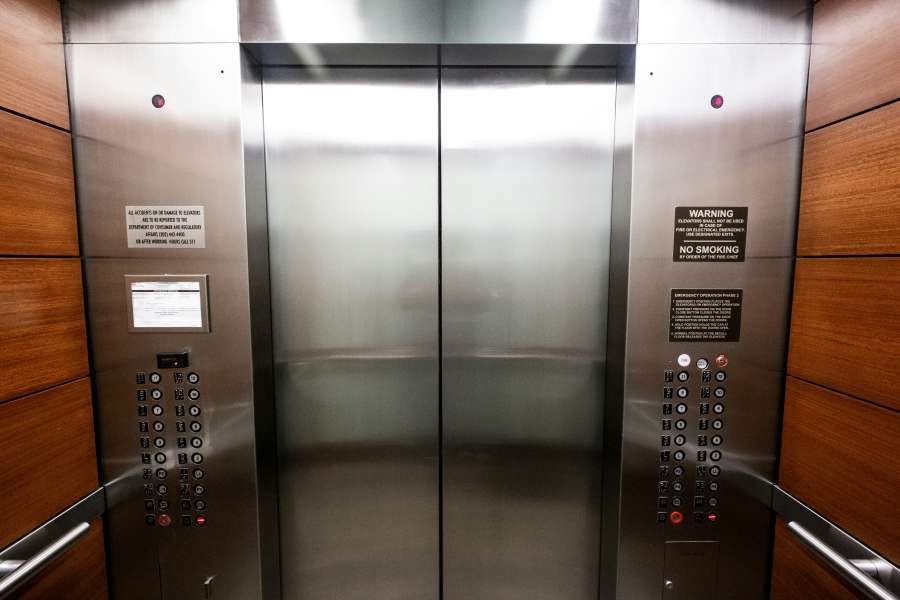
Upgrading elevator cabs requires coordinating mechanical labor, cabling, display hardware, and central station monitoring.
| Item / Service | Basic / New Build | Mid-Range Retrofit | High-End / High-Rise |
|---|---|---|---|
| In-Cab Display & Camera | $1,200 – $1,800 | $1,800 – $2,800 | $2,800 – $4,200 |
| Elevator Mechanic Labor | $800 – $1,500 | $1,500 – $2,500 | $2,500 – $4,000 |
| Traveling Cable / Extenders | $300 – $600 (Pre-wired) | $600 – $1,400 (Coax/Pair Extender) | $1,500 – $3,500 (New Cable Pull) |
| Cellular POTS Gateway / IP Router | $400 – $700 | $600 – $900 (Dual-SIM) | $900 – $1,400 (Multi-Cab Hub) |
| Monthly Monitoring & Data | $45 / mo per cab | $65 – $85 / mo per cab | $90 – $130 / mo per cab |
Network & traveling cable retrofit expenses
Transmitting video data from a moving cab to the machine room is the most volatile expense. Legacy phones used single-pair copper wire. IP video data requires high-speed network transport.
Facility managers have three primary paths for network delivery:
- Ethernet-over-Coax (EoC) or Pair Extenders: $400 – $800. Uses existing spare copper pairs or coax in the traveling cable to pass high-speed network traffic, eliminating expensive cable-pull labor.
- New traveling cables: $2,500 – $6,000 per bank. Required if existing traveling cables have no spare conductors or damaged wiring. Licensed elevator crew must hang and balance new traveling cables in the hoistway.
- In-hoistway wireless bridges: $800 – $1,600. Uses directional transceivers under the cab and at the top/bottom of the hoistway to beam video data wirelessly. Ideal for high-rises prone to cable signal loss.
💡 Derek’s Pro Tip: Demand a continuity test on existing spare conductors before paying for new traveling cables. Spare copper pairs support IP extenders in 80% of retrofits.
How to minimize elevator video retrofit costs
With elevator service companies marking up hardware and subcontractors adding margins to monitoring contracts, property managers can take specific steps to control total project expenditure.
- Demand open-architecture hardware: Avoid proprietary hardware locked to a single elevator company. Sourcing open-architecture screens lets you switch elevator mechanics or monitoring centers freely.
- Consolidate cellular gateways across cabs: Do not buy separate cellular routers for every cab. Install a single multi-port Managed POTS Replacement gateway in the machine room. Connecting all cab extenders to one gateway lowers monthly cellular data bills.
- Bundle upgrades with scheduled modernization: Combine video installations with cab refinishing or controller modernizations. Doing both together avoids standalone emergency service fees.
Avoid failed inspections and cab red tagging
Upgrading passenger elevators for ASME A17.1 video compliance averages $3,500 to $8,500 per cab.
Building owners save thousands by choosing open-architecture hardware, reusing spare traveling cable wires, and consolidating connections with a Managed POTS Replacement gateway.
Need managed POT Replacement quotes? Contact Dialvice today.
Shopping for the exact cloud phone system? Start here. 👇
Frequently Asked Questions
Do older elevators require retrofits for ASME A17.1 video monitoring?
Not immediately. Existing elevators are usually grandfathered under their original install codes. However, major modernizations or controller alterations trigger current ASME code enforcement by the local inspector.
What happens if a trapped passenger does not press YES or NO?
If a passenger does not respond to visual text prompts within 30 to 60 seconds, the monitoring operator reviews the live camera feed. If an unresponsive passenger is visible, emergency first responders dispatch immediately.
Can we use existing building Wi-Fi for elevator video monitoring?
No. ASME A17.1 Section 2.27.1.1.4 mandates at least 4 hours of dedicated emergency standby power for cab emergency communications. Commercial Wi-Fi networks lack this battery backup, signal isolation, and NFPA 72 standby power compliance.
How does a Managed POTS Replacement gateway handle elevator video and voice?
A Managed POTS Replacement gateway provides dual-path cellular connectivity and battery backup. It routes traditional voice signals alongside IP video data over a single secure network hub.
Notice: For informational purposes only. Emergency systems must be installed by certified professionals to ensure local code compliance.
